Marshall Review

The lighter side of Marshall on policy.

Marshall Review has moved to review.marshall.ie.

I originally set it up on a .re domain as a way to test the platform and to write in an unedited, off‑the‑cuff mode. Like many writers, I’ve felt the friction of the tools available to us – the heaviness of some platforms, the awkwardness of others, and the constant negotiation between writing and the systems that are supposed to support it.

This move from .re to .ie reflects a simple shift: Marshall Review becomes an edited, intentional space, while the unedited commentary continues elsewhere.

I’m keeping the lighter, provisional writing – the “Field Notes”, the quick observations, the unpolished commentary – at notes.marshall.re, where it belongs. That space remains informal and exploratory.

“Marshall Review” stays focused, edited, and deliberate. It now joins its sister columns at Marshall – Marshall On Policy (policy.marshall.ie on Substack) and Essays (essays.marshall.ie on self‑hosted WordPress), where some content is also being redirected. “Field Notes” remains here on Write.as at notes.marshall.re — loose, reflective, and off the cuff.

Is poor education to blame for the fact that so many native English speakers can’t use bring and take correctly? Or have we collectively lost the ability to imagine where we are standing at any given moment?

Last week I read a piece in the Irish Independent in which a prominent journalist wrote something along the lines of: “an injured person was brought to the hospital.”

Really? Brought?

Was the journalist personally accompanying the ambulance? Were they clinging to the back bumper with a notebook and a sense of duty? Of course not. They were at their desk, probably eating a sandwich.

The correct verb is taken. As in: “the injured person was taken to the hospital, while the reporter remained safely at their keyboard.”

Where was the sub‑editor? Possibly also at lunch, – perhaps nibbling on the other half of that sandwich.

But, bring and take aren’t decorative. They contain actual information about location – a concept that, judging by modern usage, is now considered optional – like ironing, or basic geography.

Take these two sentences:

- “I will bring my laptop from home to the office.”

Translation: I am currently at the office, and I am promising to arrive tomorrow with my laptop and, presumably, a sense of purpose.

- “I will take my laptop from home to the office.”

Translation: I am not at the office. I might be at home. I might be in a café. I might be in a field. But I am definitely not at the office.

Now consider:

“I’m going to bring my colleague to the airport” versus

“I’m going to take my colleague to the airport.”

If you say bring, you are speaking from the airport. Perhaps you live there now. Perhaps you’ve set up a small tent beside Departures? Perhaps I need to contact Focus Ireland on your behalf?

If you say take, you are somewhere else – anywhere else – but not at the airport.

This is not advanced linguistics. This is not quantum mechanics. This is kindergarten‑level spatial reasoning. And yet, somehow, it’s evaporating.

Maybe it’s laziness. Maybe it’s the collapse of editorial standards. Maybe we’ve all become so dependent on GPS that we no longer know where we are unless a mobile phone tells us.

But the distinction matters. Language loses something when we stop caring about perspective. And frankly, if we can’t manage bring and take, I fear for the future of lend and borrow.

“Borrow me your blue pencil, will you – the chief already has a lend of mine.”

Montory, France.
On guitars, wool, and the weather that shapes us

I played a Yamaha guitar today. The acoustic equivalent of a well‑made beige jumper. Solid. Reliable. No surprises… And sadly – no stories spun into the wool.

I picked up a budget Taylor. A jumper with a colourful knitted pattern on the front, tight rib cuffs. A bit of flair. A bit of “designed for comfort and optimism.” Still mass‑produced, but with a smile knitted in.

Me… I’m wearing 100% Irish wool, knitted in Mayo. A blue marl hooker‑skipper’s sweater: 1×1 rib, plain neck and cuffs that roll up…practical, weather‑ready… paired with a blue duffel coat. That’s not just clothing. That’s identity, heritage, and purpose. It’s the opposite of beige. It’s the opposite of mass‑produced optimism. It’s lived‑in, local, functional, and quietly expressive.

…And here’s the lovely thing: my guitars mirror my knitwear. They’re not beige… not patterned for effect. They’re built for weather, story, and work.

Today, I will be playing mainly Irish wool, whilst I watch the sea tell me why.

Skerries, Ireland.

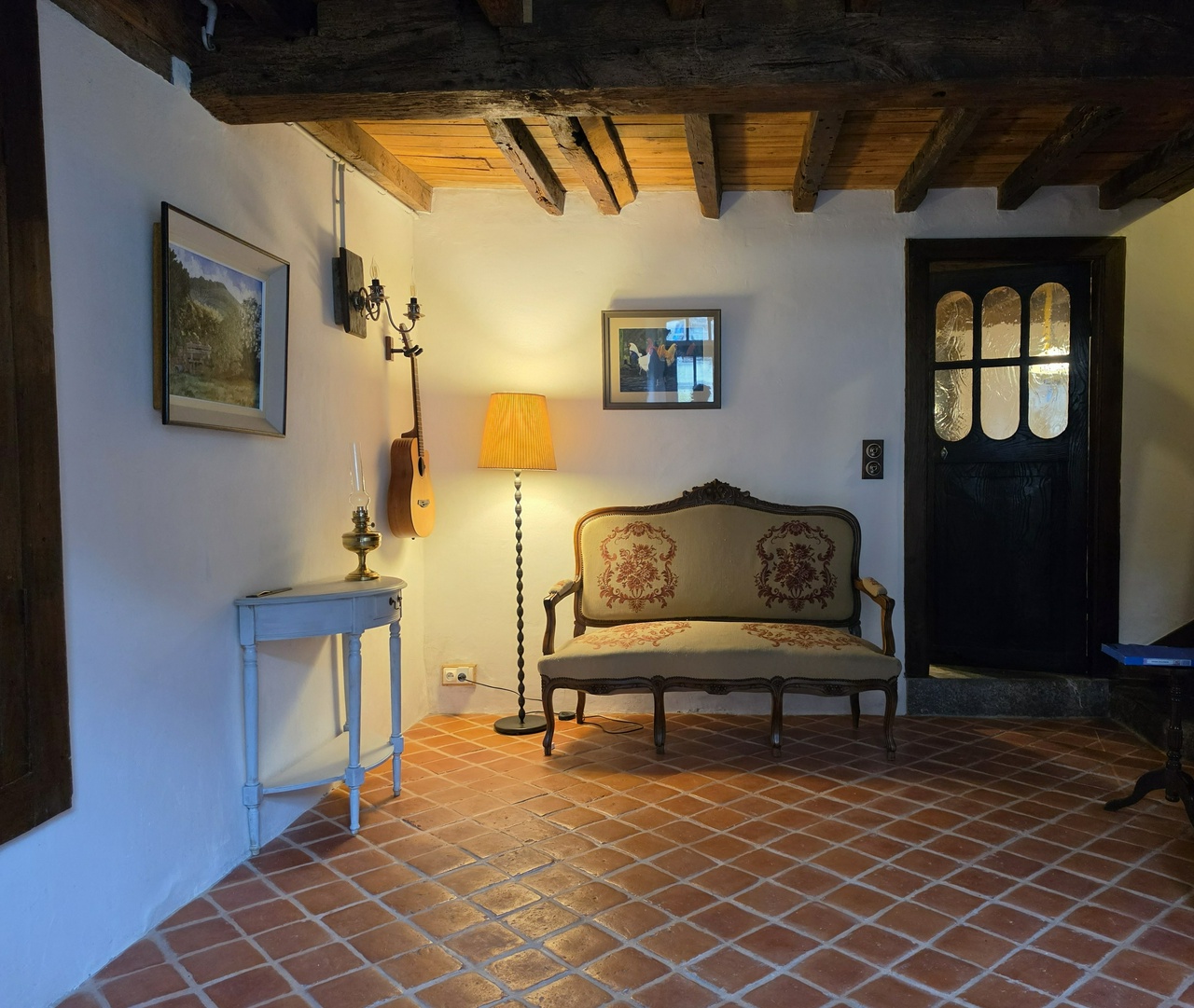
The eskeratz

The eskératz (entrance hall)

A Louis XV canapé (1920s copy). A Furch acoustic guitar and a Directoire-style demi-lune table, both furniture pieces from provincial workshops in southwest France, all acting together as a hinge. Two oil paintings — one of local hens, the other of the back garden — illustrate what actually matters and complete the décor.

The oil lamp, from the 1890's is both functional and necessary. Power outages are frequent.

This room is the main working space of a late 16th‑century town house, opening directly onto the street. As the most public-facing area of the building, it served as an important point of contact between the household and the wider community. With its long-standing association with the church, the room was historically accessible to local people and played a semi-public role within the life of the town. The presence of the canapé continues this tradition, helping to create an atmosphere in which visitors feel comfortable and welcome.

Montory, France.

Watching someone on YouTube unbox a gadget like they’re defusing a bomb. Every layer examined. Every tab pulled – with ceremony. The device itself is the least interesting part.

Swords, Ireland.

Enter your email to subscribe to updates.